The RRR Model
— A Balanced Approach To Reform...
The RRR Model is built on the principle of balance — creating pathways that both prevent harm and support rehabilitation, while strengthening communities and reducing long-term social costs.
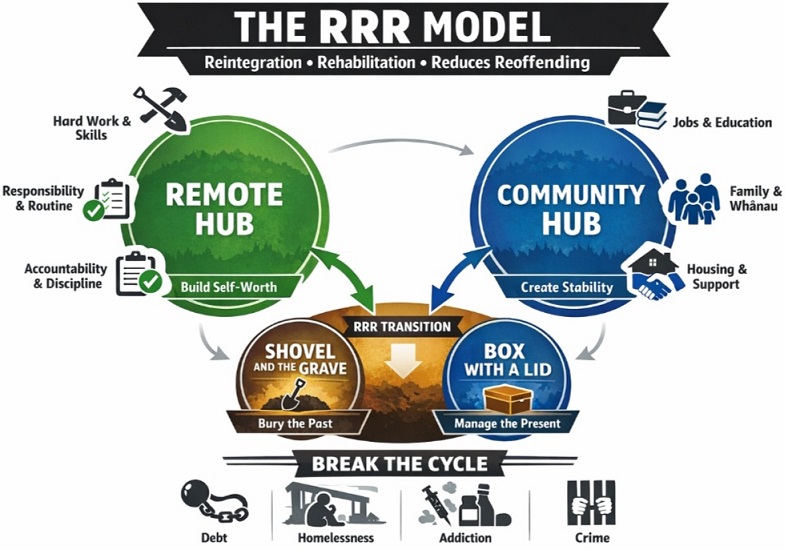
Hub Structure
Remote Hubs
Designed to support individuals who have committed serious offences or those identified as being on a pathway toward serious offending. These hubs provide structured environments focused on accountability, rehabilitation, and behavioural change, away from high-risk environments.
Community Hubs
Focused on individuals living in the community who may be struggling to reintegrate, including those with low-level convictions or non-conviction challenges such as unemployment, homelessness, or social disconnection. These hubs provide support, mentoring, and practical pathways back into stable community life.
Who Operates the Hubs?
The hubs are led by a collaborative workforce combining lived experience and professional expertise.
Lived experience leadership may include individuals with backgrounds in:
- Former incarceration
- Gang-affected whānau environments
- State care experiences
- Homelessness
- Mental health challenges
- 501 deportee experiences
Working alongside professionals from sectors such as:
- Former Police
- Former Corrections
- Former Ministry of Social Development (MSD)
- Former Oranga Tamariki (OT)
- Former Health and Social Services
This blended approach ensures credibility, cultural understanding, accountability, and practical expertise.
Who Implements the RRR Model?
The RRR Model can be partially or fully implemented by a wide range of partners seeking to create meaningful social impact, including:
- Homeowners and property owners
- Hapū and iwi organisations
- Local community groups
- Business owners
- Social service providers
- Charities and non-profit organisations
- Local councils
- Government departments and contracted providers
Benefits for Participating Communities and Partners
Implementation of the RRR Model provides both social and economic benefits, including:
- Higher and more stable rental yields for participating properties
- Self-sustaining revenue models
- Increased community resilience
- Greater access to support pathways for vulnerable individuals
- Practical solutions to prevent and address social issues
Expected Outcomes
By addressing issues early, holistically, and within community-based frameworks, the RRR Model aims to achieve:
- Fewer victims of crime
- Reduced government spending on crisis responses
- Less trauma within communities
- Reduced homelessness
- Lower levels of debt and financial instability
- Reduced crime and reoffending
- Stronger and more stable whānau
- Reduced abuse and violence
Enquiries and Implementation
We are now accepting enquiries from hapū, iwi, and communities across Aotearoa interested in implementing part or all of the RRR Model within their whenua, properties, or community initiatives.
Our team is available to discuss how the RRR Model can be adapted to meet the needs of your community while creating sustainable positive outcomes.